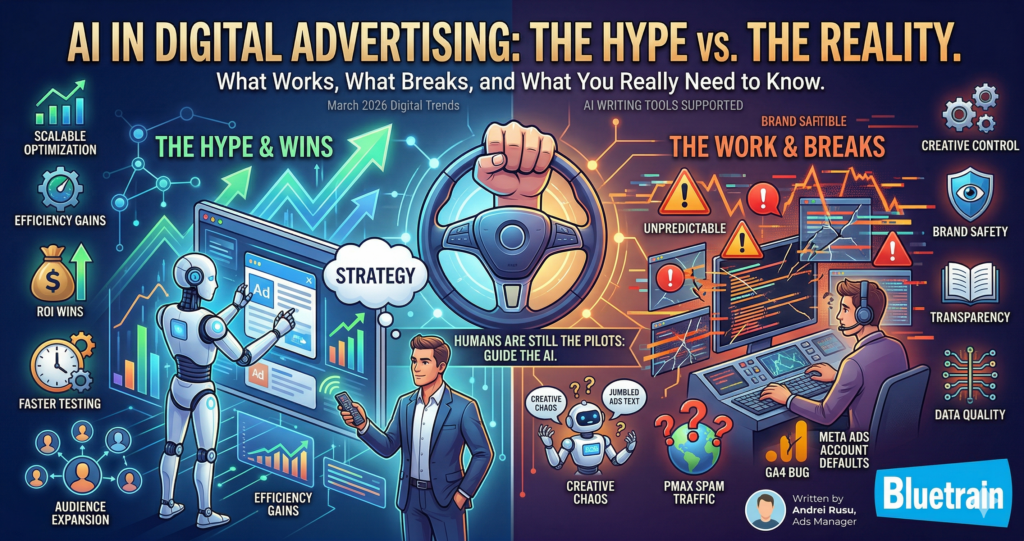
AI in digital advertising is everywhere. Google Ads, Meta Ads, Bing, LinkedIn — you name it. Every platform promises smarter optimization, faster testing, and campaigns that practically run themselves. Sounds amazing, right? But if you’ve been in the trenches lately, you know the reality is a little… unpredictable.
AI is powerful, yes, but it’s not magic. And it definitely doesn’t replace human strategy. Sometimes, it even feels like you’re babysitting the system more than running it.
The Real AI Concerns Everyone Talks About
Let’s be honest. The first thing most marketers, clients, and even sales teams mention when we talk about AI is creative control. People worry: “Is AI going to write my headlines? Rearrange my creative? Send messaging off-brand?” And the answer is yes… sometimes more than you’d like.
Then there’s transparency. Platforms optimize behind the scenes. Budgets shift, bids fluctuate, audiences expand — and you’re left staring at charts trying to figure out why. Google Ads Performance Max (PMAX) campaigns, for example, can move spend between placements without explaining exactly why. Meta’s Advantage+ campaigns do the same. It’s like watching your kid bake cookies without telling you what ingredients they used.
Brand safety is another big concern. AI can serve ads in placements you wouldn’t want or tweak messaging in ways that don’t feel right. Even when platforms promise “control,” early-phase campaigns — especially PMAX or Display — can pull in low-quality traffic or impressions from outside your intended regions.
Finally, there’s data quality and integration bugs. AI optimization relies heavily on clean signals. Small issues in GA4 imports, conversion tracking, or campaign settings can throw off your performance. And over-reliance on AI can sometimes make human oversight feel less important — until things go wrong.
How AI Advertising Actually Works
AI isn’t some mystical overlord taking over your account. It works mainly in two areas: creative and optimization.
On the creative side, AI assembles and tests asset combinations. It takes your headlines, images, videos, and descriptions and dynamically creates thousands of variations to see what works. It adapts formats automatically — square, vertical, horizontal — depending on the placement. Google Ads’ PMAX, Meta Ads’ Advantage+, and LinkedIn’s automated creative testing do this at scale.
On the optimization side, AI manages bidding, audience targeting, and budget allocation. Google’s Target CPA and ROAS models adjust bids automatically. Meta’s predictive audience expansion finds users you may not have manually targeted. LinkedIn’s AI does the same for professional audiences. AI reallocates spend toward what’s performing best and adjusts pacing throughout the day.
It’s fast. It’s efficient. But it still depends on good creative, accurate signals, and human guidance. Without those, even the smartest AI can stumble. Yes, even AI can have a “Monday mood.”
Where AI Advertising Breaks (Yes, It Happens) & How to Fix
Let’s get real. AI isn’t perfect. Here’s what we’ve seen firsthand — and what marketers are talking about across Reddit, Slack, and forums:
1. Auto-Generated Assets Ignoring Settings (Google Ads)
Even when all auto-apply and AI-assisted creative settings are disabled, Google can still generate new headlines, descriptions, and videos. One colleague noticed that deleting auto-generated ads just triggers the system to create new ones. The fix? Manually turn it off in each ad — a step many marketers won’t even know exists.
2. PMAX and Spam Traffic
Performance Max can be amazing, but early campaign phases can be tricky. Even with precise geotargeting, AI sometimes pulls traffic from outside your area — mobile-heavy and low-quality. It usually stabilizes after a day or two, but you need negative location lists applied from day one.
3. GA4 Conversion Imports Gone Wrong
Importing events from GA4 into Google Ads can throw errors if events have an auto-assigned category. Adjust the GA4 event, remove the auto category, and select it manually in Ads — problem solved. Small bug, but confusing.
4. Ads Advisor Recommendations Misfiring
Google’s Ads Advisor Beta sometimes sends recommendations for one account into a completely different account. Reddit and Slack are full of marketers sharing these funny-yet-frustrating stories.
5. Meta Ads Defaults Gone Wrong
When creating campaigns, the optional “Ad Transparency” setting can default to another account alphabetically in Business Manager. Miss clearing it, and the wrong account gets credit. Not great. Meta, we see you… we’ll keep an eye.
6. Rapid AI Rollouts
Platforms are releasing AI updates faster than anyone can test. Google’s March 2026 spam update, AI-powered Search Console configurations, original conversion value metrics, and Universal Commerce Protocol all illustrate the pace of change (Spam Update, Search Console AI, UCP). Marketers have to react quickly, or risk wasted spend and misaligned campaigns.
Why Humans Still Matter in Ad Ops
Here’s the truth: AI can do a lot, but humans still control the show. Your inputs — creative assets, tracking signals, audience parameters — dictate how well AI performs. Neglect these, and you’ll spend more time fixing mistakes than enjoying efficiency gains.
From disabling auto-generated ads, blocking spammy PMAX traffic, to tweaking GA4 imports — the marketer’s touch is still essential. AI is a tool. Humans are the pilots.
Where AI Still Wins Big
When used correctly, AI is a huge help. It allows faster creative testing, better budget allocation, and scalable optimization. Platforms like Google Ads, Meta, LinkedIn, and StackAdapt can predictively place ads, adapt formats, and reach audiences at a scale humans couldn’t manage manually.
For marketers who stay involved — guiding AI, checking signals, and applying strategic guardrails — this translates into real ROI wins and less repetitive manual work.
Bottom Line
AI in advertising isn’t perfect — but it’s powerful. The best results come from guiding AI, not letting it run unchecked. Think of it as a partner (a new coworker): one that can execute at incredible scale but still needs human oversight, clear creative, and smart strategy.
It’s unfinished, a little messy, but undeniably formidable. The gap between promise and reality is where modern marketers thrive. Those who master it will see faster results — without losing control of their brand or spend.
Ready to Take Control of AI in Your Ads?
AI is powerful, but it works best when humans guide it. That’s where we come in. At Bluetrain, we’ve spent 19+ years helping developers, builders, and marketers navigate the ever-changing world of digital campaigns — from Google and Meta to programmatic and LinkedIn.
Whether you need help understanding AI quirks, optimizing campaigns, or just making sure your creative hits the mark, we’ve got you. We love helping our clients turn clicks into meaningful engagement, engagement into leads, and leads into real-world results.
So, if you want a team that can guide, explain, troubleshoot, and brainstorm the next big idea with you — give us a shout. We’ll make it clear, actionable, and maybe even a little fun along the way.
This article was written by Andrei Rusu, Ads Manager at Bluetrain, with support from AI writing tools